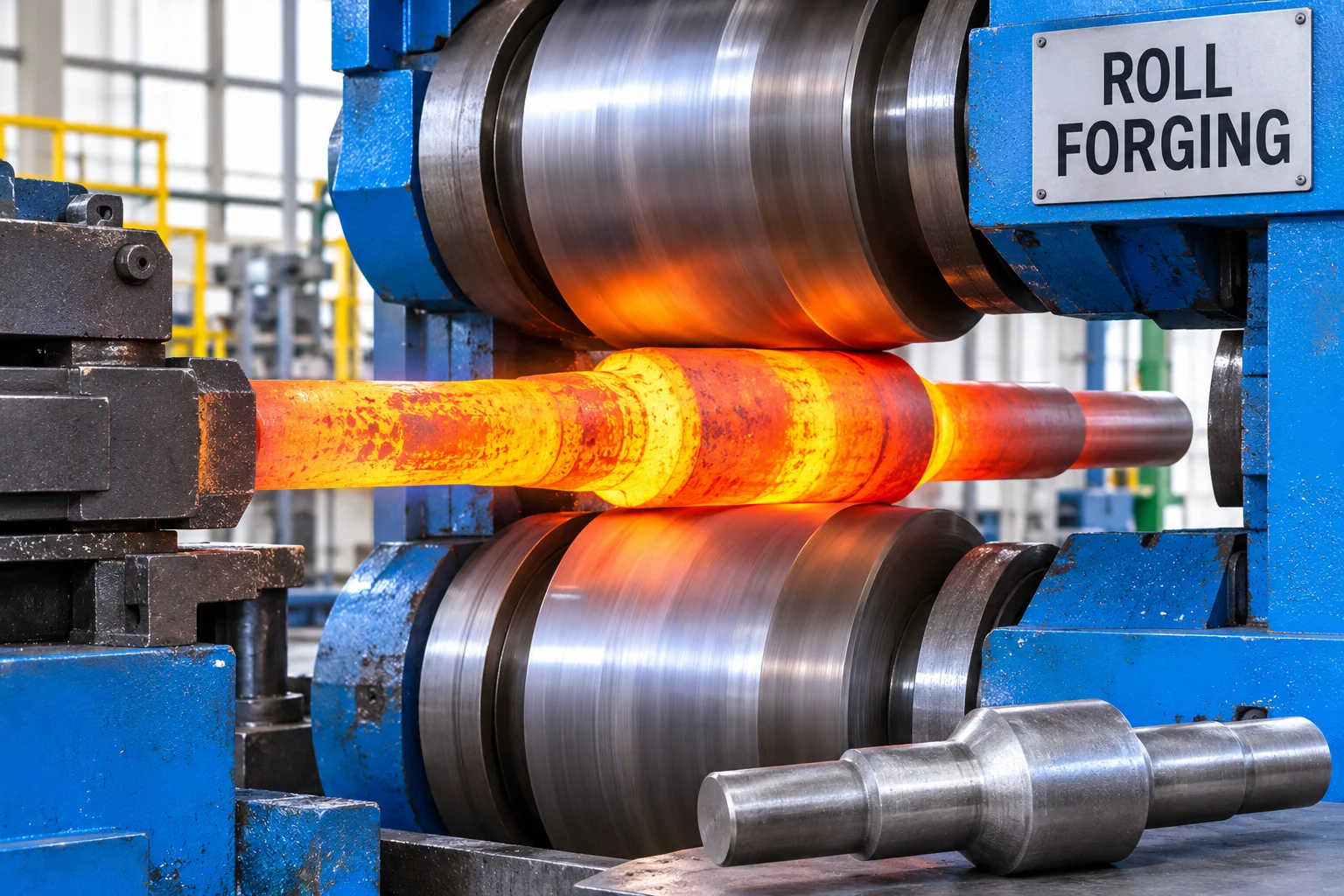
Roll forging (also known as hot forge rolling) is a metal-forming process that reduces the cross-sectional area and changes the shape of heated metal bars, billets, or plates by passing them between two counter-rotating rolls with shaped grooves. It is widely used both as a standalone shaping method and as a preforming step before closed-die or hammer forging.
How the Process Works
- Heating: Metal stock commonly carbon steel, alloy steel, stainless steel, aluminum, or copper alloys is heated to forging temperature (often around 1,050–1,150°C for steels).
- Feeding and Rolling: A worker or automated manipulator places the heated piece between two driven rolls containing matching grooves. As the rolls rotate, they grip and pull the metal through, reducing its thickness and increasing its length.
- Multi-Pass Shaping: The workpiece is moved to subsequent grooves or reinserted until it reaches the target profile or preform geometry.
- Post-Processing: Parts often undergo heat treatment, machining, or secondary forging stages depending on final requirements.
Roll forging is a metal forming process used to reduce the cross-section of a heated metal billet and shape it into a required profile using rotating rolls. It is widely used in the manufacturing industry to produce components with specific shapes, improved grain flow and consistent mechanical properties. Unlike conventional machining, which removes material to achieve the desired shape, roll forging reshapes the existing metal through controlled plastic deformation.
The roll forging process is commonly used for manufacturing automotive components, agricultural machinery parts, hand tools, connecting rods, axles, shafts and other industrial products. It is particularly suitable for producing elongated components with varying cross-sections, where material distribution and dimensional consistency are important.
During the process, a heated metal workpiece passes between two rotating rolls containing specially designed grooves. These grooves gradually reduce the cross-sectional area and change the shape of the workpiece. The metal flows into the required profile under compressive forces generated by the rolls.
Roll forging offers several manufacturing advantages, including reduced material waste, improved structural strength, better grain orientation and high production efficiency. However, achieving consistent results requires proper billet preparation, roll design, temperature control and process planning.
Understanding the different types of roll forging, manufacturing stages, materials, applications and quality considerations helps manufacturers select the right metal forming method for their production requirements.
What Is Roll Forging?
Roll forging is a hot metal forming process in which a heated workpiece is compressed and shaped between two rotating rolls with specially designed grooves. The rolls apply pressure to the material, reducing its cross-sectional dimensions and producing the required component geometry.
The process uses plastic deformation rather than material removal. As the workpiece passes through successive roll grooves, its shape changes gradually. The metal is redistributed along the length of the component while maintaining the required material volume, allowing manufacturers to produce different cross-sectional profiles.
In most industrial applications, roll forging is performed at elevated temperatures to improve metal ductility and reduce the force required for deformation. The exact forging temperature depends on the material composition, alloy characteristics and manufacturing specifications.
Roll forging is particularly effective for producing parts with different thicknesses along their length. For example, an automotive connecting rod may require thicker sections near the ends and a comparatively thinner central section. Roll forging can distribute material into these different regions before subsequent forging or finishing operations.
The process is used in both standalone manufacturing operations and as a preforming stage before closed-die forging.
How Does the Roll Forging Process Work?
The roll forging process involves several controlled manufacturing stages. Each stage contributes to the final shape, dimensional accuracy and mechanical performance of the forged component.
1. Material Selection and Billet Preparation
The first step involves selecting a suitable metal according to the component's mechanical and operating requirements. Common materials include carbon steel, alloy steel, stainless steel and certain non-ferrous metals.
The selected material is cut into billets of the required length and weight. Proper billet dimensions are important because the volume of metal must be sufficient to fill the intended profile without creating excessive material or underfilling.
Before processing, manufacturers inspect the billets for surface defects, cracks, dimensional variations and material inconsistencies.
2. Heating the Metal Billet
For hot roll forging, the prepared billet is heated in an industrial furnace to the appropriate forging temperature.
Heating improves the material's plasticity and makes it easier to deform under the pressure of the rotating rolls. Temperature control is important because insufficient heating can increase forming resistance, while excessive heating may cause oxidation, scaling, grain growth or other metallurgical problems.
The heating method depends on production volume, billet dimensions and material requirements. Gas-fired furnaces and induction heating systems are commonly used in industrial forging operations.
3. Feeding the Billet Between the Rolls
After reaching the required temperature, the billet is positioned and fed between two rotating rolls.
The rolls contain grooves designed according to the required component profile. As the billet enters the roll gap, friction between the workpiece and the roll surfaces helps draw the material into the forming zone.
Proper alignment and feeding are important to prevent twisting, uneven deformation and dimensional variations.
4. Metal Deformation and Shape Formation
The rotating rolls apply compressive forces to the heated billet. As the workpiece moves through the grooves, its cross-sectional area decreases and its length generally increases.
The deformation takes place progressively through a sequence of roll passes. Each pass produces a controlled change in the material's shape.
The grooves are designed to distribute the metal into the required sections. This helps create different thicknesses and profiles along the length of the workpiece.
5. Intermediate Inspection and Temperature Control
During multiple-pass roll forging, manufacturers may inspect the workpiece between operations.
Important parameters include:
- Workpiece temperature
- Cross-sectional dimensions
- Material flow
- Surface condition
- Alignment and deformation consistency
Maintaining suitable temperature between passes helps prevent excessive forming resistance and unwanted material defects.
6. Final Forming and Finishing
After the required roll passes are completed, the workpiece reaches its intended preform or final profile.
Depending on the product, additional operations may include trimming, bending, closed-die forging, heat treatment, straightening, shot blasting and machining.
The finished component is inspected to verify its dimensions, surface quality and mechanical properties according to the applicable manufacturing requirements.
Types of Roll Forging
Roll forging can be classified according to the machine configuration, roll arrangement and manufacturing application. Different roll forging methods are selected based on component geometry, production volume and required deformation.
1. Two-Roll Forging
Two-roll forging is the conventional roll forging arrangement. It uses two rotating rolls positioned opposite each other, with grooves machined into their working surfaces.
The heated metal billet passes through the space between the rolls and undergoes progressive deformation.
This method is commonly used for reducing cross-sections and producing elongated components with different thicknesses along their length.
Applications:
- Automotive connecting rods
- Axle preforms
- Agricultural equipment components
- Hand tool blanks
- Industrial shafts
2. Multi-Pass Roll Forging
Multi-pass roll forging involves passing the workpiece through a series of grooves to achieve the required profile gradually.
Instead of producing the complete shape in one operation, each pass performs a specific amount of deformation.
This approach provides better control over material flow and helps reduce the risk of excessive deformation in a single pass.
Multi-pass roll forging is suitable for components with complex cross-sectional changes and demanding material distribution requirements.
3. Cross-Roll Forging
Cross-roll forging is a related rotary forming method in which the workpiece is deformed between rolls arranged to produce controlled changes in its cross-section.
Depending on the machine configuration and roll geometry, the process can produce rotationally symmetrical or elongated preforms.
It is particularly useful in manufacturing operations where controlled material redistribution is required before further forming.
Cross-roll forging should not be confused with conventional roll forging, as the workpiece movement, deformation pattern and resulting geometry can differ.
4. Rotary Roll Forging
Rotary roll forging refers to roll-based forming operations in which rotating tools progressively deform the workpiece.
The exact arrangement depends on the machine and component design. Rotary forming methods are useful when manufacturers need repeatable deformation and continuous or progressive material shaping.
The term may also be used broadly for related rotary metal forming technologies, so the specific machine configuration should be considered when evaluating a process.
5. Hot Roll Forging
Hot roll forging is performed when the workpiece is heated above its recrystallisation temperature range, according to the material and process requirements.
Heating improves ductility and makes it possible to achieve substantial deformation without requiring excessively high forming loads.
It is widely used for steel components and industrial applications requiring significant cross-sectional reduction.
6. Warm Roll Forging
Warm roll forging is performed at temperatures below conventional hot forging temperatures but above room temperature.
It combines certain advantages of hot and cold forming. Depending on the material, warm forming can provide better dimensional control and surface quality than conventional hot forging while requiring less forming force than cold working.
However, the suitable temperature range and achievable deformation depend on the material being processed.
Important Features of Roll Forging
Roll forging has several characteristics that make it useful for industrial metal forming.
Controlled Cross-Section Reduction
The process reduces the cross-sectional area of a metal billet through successive deformation stages. This makes it suitable for producing components with different thicknesses and profiles.
Progressive Material Flow
Metal is gradually redistributed through specially designed grooves. This helps manufacturers control the amount of material flowing into specific sections.
Improved Grain Flow
During hot deformation, the metal's grain structure changes according to the direction and amount of deformation.
When the component is properly designed and formed, grain flow can follow the geometry of the part. This may improve resistance to mechanical loading compared with components produced through certain machining operations.
High Production Efficiency
Roll forging can be integrated into automated manufacturing lines. Once the rolls, grooves and process parameters are established, repetitive production can be performed efficiently.
Material Utilisation
Since the process reshapes existing material rather than removing large amounts through machining, it can reduce material waste in suitable applications.
Advantages of Roll Forging
Roll forging provides several technical and economic advantages when applied to the correct component geometry and production requirements.
1. Improved Mechanical Strength
One important advantage of roll forging is its ability to produce favourable grain flow patterns.
During deformation, the grain structure follows the material flow. When the component geometry and forging sequence are properly designed, this directional grain flow can improve mechanical performance in service.
The actual strength and fatigue performance depend on material composition, deformation conditions, heat treatment and final component geometry.
2. Reduced Material Waste
Traditional machining removes unwanted material from a larger metal block. Roll forging reshapes the billet, allowing more of the original material to remain in the finished component.
This can reduce material consumption, particularly when manufacturing components with varying cross-sections.
3. High Production Rate
Roll forging is suitable for repetitive production because the rolls can perform multiple forming operations through a controlled sequence.
In high-volume manufacturing, this can reduce cycle times compared with some conventional forming methods.
4. Better Material Distribution
The process allows manufacturers to move material from one section of a billet to another.
This is particularly useful for components that require different cross-sectional dimensions along their length.
5. Reduced Machining Requirements
Because roll forging produces a near-net or preformed shape, it can reduce the amount of material that must be removed during subsequent machining.
However, precision surfaces, holes, threads and tight dimensional tolerances may still require machining.
6. Suitable for Complex Preforms
Roll forging can create intermediate shapes that would be difficult or inefficient to produce through simple cutting operations.
These preforms can subsequently be finished using closed-die forging or other manufacturing processes.
7. Consistent Production Quality
When billet dimensions, temperature, roll alignment and forming parameters are properly controlled, roll forging can produce repeatable results.
Consistent production depends on equipment condition, die maintenance and effective quality inspection.
Disadvantages and Limitations of Roll Forging
Although roll forging offers several advantages, it also has certain limitations.
1. High Initial Equipment Investment
Roll forging machines, specialised rolls and tooling require investment. Custom roll grooves may also increase initial tooling costs.
This makes the process more economical for suitable production volumes than for very small batches.
2. Tooling Design Complexity
Roll grooves must be designed according to the material, billet dimensions, deformation sequence and final component geometry.
Incorrect groove design can result in uneven material flow, underfilling or dimensional variations.
3. Limited Component Geometry
Roll forging is especially suitable for elongated components with varying cross-sections. It is not the ideal process for every shape.
Parts with complicated three-dimensional geometries may require closed-die forging, machining or other forming processes.
4. Temperature Control Requirements
Hot roll forging requires careful control of billet temperature.
Improper heating or excessive cooling between passes can affect material flow, surface condition and final mechanical properties.
5. Skilled Process Planning
Manufacturers need knowledge of material behaviour, deformation mechanics, roll design and process parameters to achieve consistent production results.
6. Additional Finishing Operations
Some components require further forging, machining, heat treatment, straightening or surface finishing after roll forging.
Therefore, the complete manufacturing cost should include all secondary operations.
Materials Used in Roll Forging
Material selection is an important factor in determining the performance, quality and manufacturing suitability of a roll-forged component.
Different materials are selected according to their strength, ductility, toughness, temperature resistance, corrosion resistance and intended application.
1. Carbon Steel
Carbon steel is widely used in industrial forging because of its availability, mechanical properties and manufacturing suitability.
It is commonly selected for automotive parts, shafts, agricultural machinery components and industrial tools.
The carbon content influences hardness, strength, ductility and forging behaviour.
2. Alloy Steel
Alloy steels contain additional elements such as chromium, nickel, molybdenum and manganese.
These elements are used to improve properties such as hardenability, strength, toughness and wear resistance.
Alloy steel roll-forged components are commonly used in demanding automotive and industrial applications.
3. Stainless Steel
Stainless steel is selected when corrosion resistance is an important requirement.
Its chromium content helps form a protective passive layer on the material surface.
The suitability of stainless steel for roll forging depends on its grade, work-hardening characteristics and temperature requirements.
4. Aluminium Alloys
Certain aluminium alloys can be processed using roll-based forming techniques.
Aluminium is lightweight and offers a useful combination of strength, corrosion resistance and formability.
Its forging temperature and deformation limits must be carefully controlled to prevent cracking and other forming problems.
5. Copper Alloys
Copper alloys are used in selected metal forming applications because of their electrical conductivity, thermal conductivity and corrosion resistance.
The appropriate forming method depends on the alloy composition and required component geometry.
Applications of Roll Forging in Different Industries
Roll forging is used across several industries where components require controlled material distribution, mechanical reliability and efficient production.
1. Automotive Industry
The automotive industry is one of the major application areas for roll forging.
Vehicles contain numerous components that require strength, fatigue resistance and dimensional consistency.
Common applications include:
- Connecting rod preforms
- Axle components
- Steering system components
- Transmission parts
- Suspension components
- Drive shaft preforms
Roll forging can help manufacturers create suitable material profiles before final forging and machining.
2. Agricultural Machinery Industry
Agricultural equipment operates under varying loads, vibration and demanding environmental conditions.
Roll-forged components are used in selected machinery parts where material strength and reliable performance are important.
Examples include:
- Tractor components
- Agricultural equipment shafts
- Tillage equipment parts
- Mechanical linkage components
- Machine tool blanks
3. Industrial Machinery Manufacturing
Industrial machinery manufacturers use forged components in equipment that experiences repeated mechanical loading.
Roll forging can be used to prepare elongated profiles for shafts, mechanical linkages and other industrial parts.
4. Hand Tool Manufacturing
Hand tools require a combination of strength, durability and suitable geometry.
Roll forging can produce preforms for products such as:
- Spanners
- Wrenches
- Pliers
- Hammer components
- Other forged tool blanks
5. Construction Equipment
Construction equipment operates under heavy mechanical loads and demanding working conditions.
Selected structural and mechanical components can be manufactured using roll forging or roll-forged preforms.
6. Rail and Transportation Equipment
Certain elongated metal components used in transportation equipment can benefit from controlled forming and material distribution.
The actual suitability of roll forging depends on the part geometry, material specifications and applicable engineering standards.
Roll Forging vs Other Metal Forming Processes
Roll forging is one of several metal forming techniques used in industrial manufacturing. Understanding the differences between these processes helps engineers and manufacturers choose an appropriate production method.
Roll Forging vs Open Die Forging
Open die forging involves deforming a heated metal workpiece between flat or specially shaped dies without completely enclosing the material.
Roll forging uses rotating rolls with grooves to progressively reduce and shape the workpiece.
| Comparison |
Roll Forging |
Open Die Forging |
| Working Principle |
Deformation between rotating grooved rolls |
Compression between open dies |
| Material Movement |
Progressive movement through roll grooves |
Material deforms under repeated die pressure |
| Component Geometry |
Mainly elongated profiles |
Simple to large and varied geometries |
| Production |
Suitable for repetitive production |
Suitable for small and large individual components |
| Tooling |
Specialised grooved rolls |
Open dies |
| Typical Applications |
Connecting rod preforms, shafts and tool blanks |
Large shafts, rings and heavy industrial components |
Roll Forging vs Closed Die Forging
Closed die forging uses shaped dies that enclose the workpiece and force the metal to fill the required cavity.
| Comparison |
Roll Forging |
Closed Die Forging |
| Process |
Progressive roll deformation |
Metal deformation inside shaped dies |
| Tool Arrangement |
Two or more forming rolls |
Matched die halves |
| Component Shape |
Primarily elongated profiles |
More complex three-dimensional shapes |
| Material Distribution |
Controlled through successive roll grooves |
Controlled by die cavity and billet design |
| Production Use |
Often used for preforms |
Used for final or near-net-shape components |
Roll forging uses rotating grooved rolls to progressively shape the billet.
Roll forging is frequently used before closed-die forging to distribute material into the appropriate sections of a component.
Roll Forging vs Machining
Machining removes material from a workpiece using cutting tools to produce the required dimensions and surface finish.
Roll forging changes the shape of the metal through plastic deformation.
| Comparison |
Roll Forging |
Machining |
| Material Removal |
Minimal in the forming stage |
Material is removed |
| Grain Flow |
Can follow the component geometry |
Original grain flow is interrupted by cutting |
| Material Waste |
Often lower |
Depends on the amount of material removed |
| Surface Finish |
May require finishing |
Can achieve precise surface finishes |
| Production Suitability |
Suitable for repetitive forming |
Suitable for precision features and different production volumes |
Both processes can be used together. Roll forging creates the required preform, while machining produces precision dimensions and features.
Roll Forging Machine and Equipment
A roll forging machine is designed to apply controlled pressure to a metal billet through rotating rolls.
The machine configuration depends on the component dimensions, material characteristics and production requirements.
The major equipment components include:
1. Forging Rolls
Forging rolls are the primary forming elements. Their grooves are designed to produce the required cross-sectional changes.
Roll material and heat treatment must provide suitable strength, wear resistance and service life.
2. Drive System
The drive system supplies rotational power to the rolls.
It may use electric motors, gearboxes and mechanical transmission components to achieve the required operating speed and torque.
3. Heating Furnace
A heating furnace raises the billet temperature before hot roll forging.
The furnace should provide uniform heating and controlled temperature conditions.
4. Feeding and Handling Equipment
Feeding mechanisms help position and move billets into the forming zone.
Mechanical handling systems and manipulators may be used in industrial production lines.
5. Cooling and Inspection Equipment
After forming, the workpiece may undergo controlled cooling, inspection and subsequent processing.
Depending on the material and component specifications, additional equipment may be required for heat treatment and finishing.
Important Process Parameters in Roll Forging
The quality of a roll-forged component depends on several manufacturing parameters.
Forging Temperature
Temperature influences metal ductility, deformation resistance and material flow.
The recommended temperature range depends on the selected material and its metallurgical properties.
Roll Speed
Roll speed affects the rate of deformation and material movement.
Excessive or unsuitable speeds can influence forming stability, temperature loss and production quality.
Roll Gap
The distance between the rolls determines the amount of deformation during each pass.
Correct roll gap settings help maintain the required cross-sectional dimensions.
Groove Design
Groove geometry determines how the material flows during deformation.
Proper groove design is important for achieving the intended profile while reducing the possibility of defects.
Billet Dimensions
Billet length, diameter, weight and initial cross-section must be selected according to the finished component requirements.
Incorrect billet dimensions can cause underfilling, excessive material or inconsistent deformation.
Number of Passes
The number of passes depends on the amount of cross-sectional reduction and the complexity of the final profile.
Multiple passes allow gradual deformation and improved control of material flow.
Common Roll Forging Defects and Their Prevention
Roll forging defects can affect component dimensions, surface quality and mechanical performance. Proper process planning, material inspection and machine maintenance help minimise manufacturing problems.
| Defect |
Possible Cause |
Preventive Measure |
| Surface Cracks |
Incorrect forging temperature or excessive deformation |
Maintain suitable temperature and deformation conditions |
| Internal Cracks |
Improper material flow or excessive deformation |
Optimise the forging sequence and reduction |
| Underfilling |
Insufficient billet volume or incorrect groove design |
Verify billet dimensions and roll groove geometry |
| Uneven Deformation |
Incorrect roll alignment or inconsistent feeding |
Maintain roll alignment and controlled feeding |
| Surface Scale |
Oxidation during heating |
Control furnace conditions and heating duration |
| Dimensional Variation |
Incorrect roll gap or worn grooves |
Inspect and maintain roll tooling |
| Twisting |
Improper billet positioning or uneven material flow |
Improve billet alignment and feeding control |
| Excessive Material Flow |
Incorrect billet volume or pass design |
Review billet sizing and deformation sequence |
Surface Cracks
Surface cracks may occur when the material is deformed under unsuitable temperature conditions or excessive strain.
Manufacturers should review heating practices, material quality and the amount of deformation applied during each pass.
Internal Cracks
Internal cracks can develop when the material experiences unfavourable stress conditions during deformation.
Proper billet quality, deformation planning and material inspection are important preventive measures.
Underfilling
Underfilling occurs when insufficient material reaches the intended section of the roll groove.
It may result from incorrect billet dimensions, poor groove design or unsuitable process settings.
Dimensional Variations
Dimensional variations can occur because of roll wear, incorrect roll gaps, temperature differences or inconsistent billet feeding.
Regular inspection and process monitoring help maintain dimensional consistency.
Quality Control and Inspection in Roll Forging
Quality control is an essential part of roll forging manufacturing. Components must meet the required dimensional, mechanical and metallurgical specifications before they are approved for further processing or delivery.
1. Raw Material Inspection
Manufacturers inspect incoming materials to confirm their chemical composition, material grade and condition.
Material certificates and applicable inspection records help establish traceability.
2. Dimensional Inspection
Measuring instruments are used to verify billet dimensions and finished component profiles.
Depending on the tolerance requirements, manufacturers may use gauges, callipers, micrometers and coordinate measuring machines.
3. Visual Inspection
Visual inspection helps identify surface cracks, laps, scale, marks and other visible irregularities.
4. Non-Destructive Testing
Non-destructive testing methods may be used when component specifications require additional inspection.
Common methods include:
- Magnetic particle testing for suitable ferromagnetic materials
- Ultrasonic testing for internal discontinuities
- Liquid penetrant testing for surface-breaking defects
The appropriate method depends on the material, component geometry and inspection requirements.
5. Mechanical Testing
Mechanical testing may include tensile testing, hardness testing and impact testing, depending on the component's application and material specification.
6. Metallurgical Inspection
Metallurgical examination can be performed to evaluate grain structure, microstructure and other material characteristics.
The inspection requirements should be established according to the applicable product specifications and engineering standards.
Factors to Consider When Selecting Roll Forging
Selecting roll forging as a manufacturing method requires evaluating the component's geometry, material and production requirements.
Important considerations include:
- Component geometry: Roll forging is most suitable for elongated components with varying cross-sections. The geometry must be compatible with the roll groove arrangement.
- Material properties: The selected material should have suitable ductility and deformation characteristics at the intended processing temperature.
- Production volume: Initial tooling and machine costs should be compared with expected production volume.
- Dimensional requirements: Manufacturers should determine which dimensions can be achieved through roll forging and which require secondary machining.
- Mechanical properties: The component's strength, fatigue resistance, toughness and operating conditions must be considered during process planning.
- Manufacturing cost: The complete production cost should include raw materials, heating, tooling, forming, inspection, finishing and machining.
- Quality requirements: Material traceability, testing and inspection requirements should be established before production begins.
Future Developments in Roll Forging Technology
Modern metal forming industries are increasingly adopting automation, digital monitoring and advanced manufacturing technologies to improve production efficiency.
Roll forging operations can benefit from several technological developments.
Automated Billet Feeding
Automated feeding systems help improve billet positioning, reduce manual handling and maintain consistent production cycles.
Temperature Monitoring Systems
Modern temperature monitoring technologies help manufacturers maintain suitable billet temperatures throughout the forming process.
Advanced Roll Design
Computer-aided design and engineering simulations can help engineers evaluate groove geometry, material flow and deformation behaviour before manufacturing the tooling.
Process Monitoring
Sensors and digital monitoring systems can track machine operating conditions, roll speed, temperature and other production parameters.
Predictive Maintenance
Monitoring machine performance and roll wear can help manufacturers identify potential maintenance requirements before equipment failures occur.
These developments can improve process consistency, equipment utilisation and overall manufacturing efficiency.
Frequently Asked Questions
1. What is roll forging?
Roll forging is a metal forming process in which a heated metal billet passes between rotating rolls containing specially designed grooves. The rolls progressively reduce the cross-sectional area and shape the workpiece into the required profile.
2. How does roll forging work?
Roll forging works by applying compressive forces through two rotating rolls. The billet passes through successive grooves, where its cross-section is gradually reduced and the material is redistributed to form the required shape.
3. What are the main types of roll forging?
Common classifications include two-roll forging, multi-pass roll forging, cross-roll forging, hot roll forging and warm roll forging. These processes differ in roll arrangement, deformation method and operating temperature.
4. What materials are used in roll forging?
Common materials include carbon steel, alloy steel, stainless steel and selected aluminium and copper alloys. Material selection depends on the component's mechanical requirements and forming characteristics.
5. What are the advantages of roll forging?
The major advantages include reduced material waste, improved grain flow, high production efficiency, controlled material distribution and reduced machining requirements for suitable component designs.
6. What industries use roll forging?
Roll forging is used in automotive manufacturing, agricultural machinery, industrial equipment, hand tool production and selected transportation and construction equipment applications.
7. What is the difference between roll forging and conventional forging?
Roll forging uses rotating grooved rolls to progressively deform a billet. Conventional forging generally uses hammers or presses with dies to apply compressive forces and produce the required shape.
8. Is roll forging a hot or cold forming process?
Roll forging is commonly performed as a hot forming process. However, warm roll forging and other temperature-dependent roll forming variations are also used for suitable materials and applications.
9. What is the purpose of roll forging in automotive manufacturing?
Roll forging is used to produce preforms and components with controlled material distribution. It is particularly useful for automotive parts such as connecting rod preforms, axle components and selected transmission and suspension parts.
10. Does roll forging improve grain flow?
Yes. Properly designed roll forging operations can orient the grain flow along the component's geometry. This can improve mechanical performance in suitable applications, depending on material properties and subsequent processing.
11. What is a roll forging machine?
A roll forging machine is industrial equipment that uses rotating rolls with specially designed grooves to deform and shape heated metal billets. It generally includes forging rolls, a drive system, feeding equipment and supporting control systems.
12. What factors affect roll forging quality?
Important factors include material composition, billet dimensions, forging temperature, roll speed, roll gap, groove design, number of passes and machine alignment.
13. Can roll forging reduce manufacturing costs?
Roll forging can reduce material waste and machining requirements while supporting efficient repetitive production. However, its economic suitability depends on tooling costs, production volume, component geometry and secondary manufacturing operations.
14. What is the difference between roll forging and cross rolling?
Conventional roll forging generally uses grooved rolls to produce elongated profiles through progressive deformation. Cross rolling is a related rotary forming technique in which the workpiece and rolls interact to produce different deformation patterns. The exact difference depends on the machine configuration and process definition.
15. What are common defects in roll forging?
Common defects include surface cracks, internal cracks, underfilling, uneven deformation, surface scale, twisting and dimensional variations. Proper temperature control, billet preparation and tooling design help minimise these defects.
Conclusion
Roll forging is an important metal forming technology used to manufacture components with controlled cross-sectional profiles, improved material utilisation and favourable grain flow characteristics. By passing heated metal billets through specially designed rotating rolls, manufacturers can progressively shape materials into elongated components with varying dimensions.
The process offers several advantages, including reduced material waste, high production efficiency, consistent deformation and reduced machining requirements for suitable component designs. It is widely applicable in automotive manufacturing, agricultural machinery, industrial equipment and hand tool production.
Successful roll forging depends on selecting the right material, maintaining appropriate forging temperatures, designing suitable roll grooves and controlling the deformation sequence. Quality inspection and process monitoring are equally important for ensuring that finished components meet their intended engineering requirements.
As industrial manufacturing continues to adopt automation, advanced tooling design and digital process monitoring, roll forging remains a valuable production method for manufacturers seeking efficient and reliable metal forming solutions.
